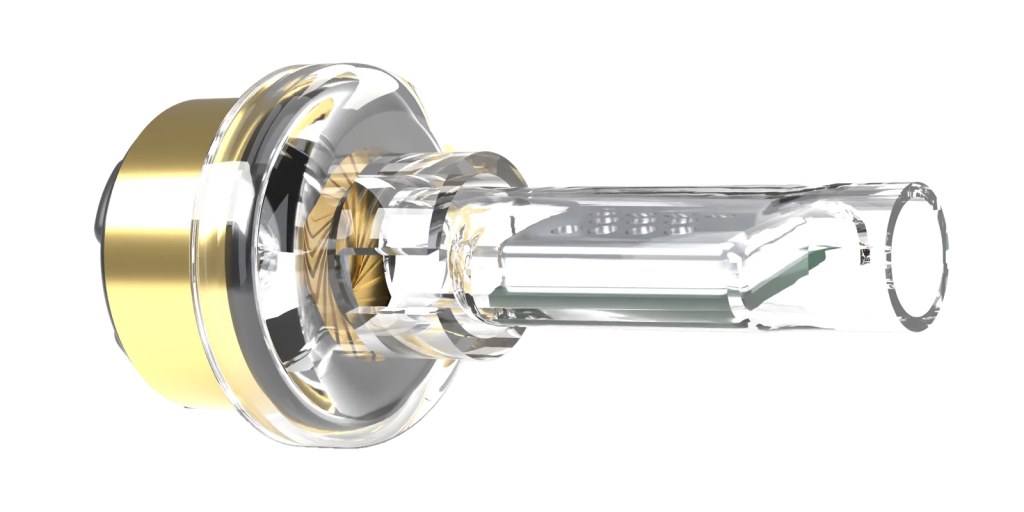
Render of the Voix acoustic assembly: the xMEMS Muir driver coupled to a tuned chamber.

SORANIK / MEMS-VOIX TECHNOLOGY

MEMS, the voice of silicon.

A solid-state transducer brought out of the treble and into the heart of music.

The MEMS-Voix system uses a purpose-built acoustic system to transform the operating environment of the xMEMS Muir, introducing a deliberately controlled resonant behavior through the vocal presence region.

MEMS
xMEMS Muir
Acoustic system
Voix
Controlled resonance
1.5–2.5 kHz
System mode
Coupled acoustic

01 / SILICON

A different kind
of moving surface.

Macro photograph of the xMEMS Muir: a rectangular silicon MEMS die with a green-reflecting membrane, seated in a gold frame, with two gold wire-bond connections at the left edge.
Specimen — xMEMS Muir · all-silicon piezoMEMS microspeaker

Built for the highs.
Chosen for something else.

Introduced by xMEMS in 2024 as its smallest piezoMEMS microspeaker, Muir is a solid-state transducer whose moving structure is fabricated in silicon. It carries very low moving mass, a comparatively high intrinsic mechanical resonance, and a package just 1.15 mm thick.

It was positioned primarily as a high-frequency transducer. Those same properties make it an unusually interesting starting point for acoustic loading experiments.

  • 01Monolithic siliconStructure
  • 023.2 × 5.0 × 1.15 mmPackage dimensions
  • 0344 mgMass
  • 0412.2 kHzMechanical resonance

Dimensions, mass and mechanical resonance per the xMEMS XSC-2200 (top-firing) datasheet, rev. 1.0, Jun. 28, 2024.

Why Muir was the better foundation for Voix

Comparison of a direct-radiating MEMS transducer (xMEMS Montara) and the Voix resonator transducer (xMEMS Muir)
Attribute Direct-radiating MEMSxMEMS Montara Voix resonatorxMEMS Muir
RoleBroad, direct reproductionSpecialized resonant loading
PackageLarger MEMS architectureCompact Muir architecture, small enough to fit the required volume constraints
ImplementationDirect radiation to the ear canalTransformed acoustic loading
PurposeReproduceHarmonics tuning

Muir was chosen for Voix because it suits the resonator. Montara has its own role in MEMS-Voix 4: full-range reproduction.

02 / TRANSFORMATION

VOIX BEGINS WITH ACOUSTIC LOAD.

Muir was designed
to reproduce high frequencies.

We asked:
what if the acoustic system
changed its role?

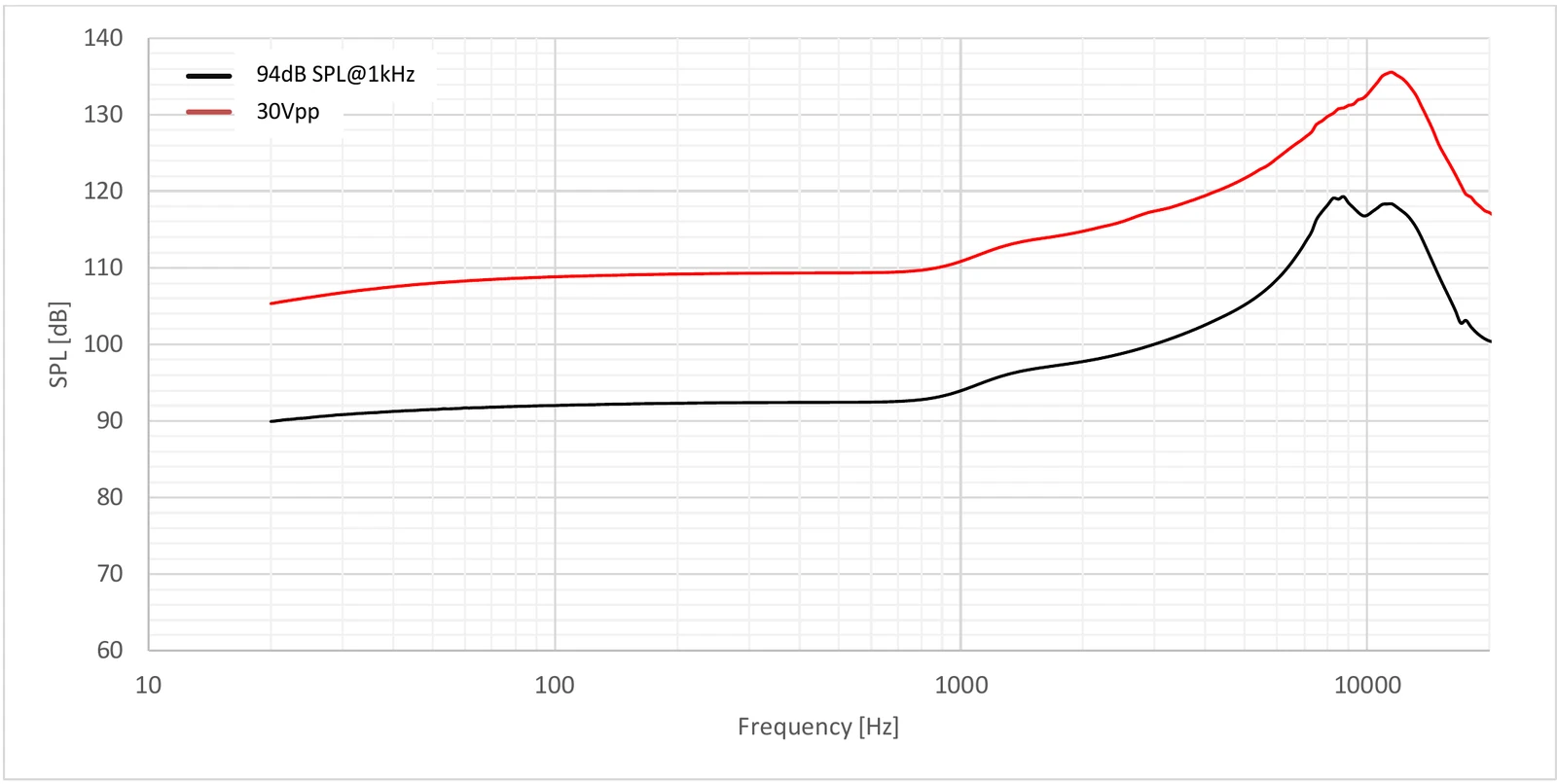
Muir full-range frequency response from the xMEMS XSC-2200 datasheet, Figure 3.2.1: SPL in dB against frequency from 10 Hz to 20 kHz, for 94 dB SPL at 1 kHz and 30 Vpp drive. Both curves are broadly flat to about 800 Hz, then rise toward a high-frequency peak.
xMEMS XSC-2200 datasheet, rev. 1.0 · p. 8 · Figure 3.2.1, full-range frequency response (IEC 60318-4 coupler)
Render of the Voix acoustic assembly: a 6 mm dynamic diaphragm in a gold housing at the left, a clear acoustic volume holding the Muir MEMS on its circuit board, and an output tube at the right.

03 / MECHANISM

Inside Voix.

The acoustic system becomes part of the transducer.

Stage 01 / Excitation

Pure silicon creates the impulse.

Muir's silicon membrane provides the initial acoustic excitation. Its compact silicon architecture allows the surrounding acoustic network to become a dominant part of the system response.

Source
xMEMS Muir
Actuation
Piezoelectric MEMS
Role
Excitation
Muir diaphragm — illustration The Muir diaphragm is two silicon fins with a small gap between them. Each fin is anchored to the silicon frame at its outer edge. When the drive signal passes through the piezo layer, both fins flap up and down together, moving air. Alternating arcs, solid for compression and dashed for rarefaction, radiate outward from the gap. Top view · 2 fins, 1 slit Silicon frame Silicon frame Fin Fin Gap AC drive signal
  • Silicon fin
  • Piezo layer
  • Compression
  • Rarefaction
  • Illustrative · slowed

Stage 02 / Coupling

The acoustic load changes everything.

The 6 mm diaphragm does more than reproduce sound. Its moving mechanical compliance also becomes part of the acoustic load seen by Muir.

Together, the MEMS driver, enclosed volume, sound path and compliant diaphragm form a coupled acoustic resonator, with Helmholtz-like behavior.

Transparent render of the Voix acoustic assembly. At the left, a 6 mm dynamic diaphragm in a gold housing; a short neck leads into a clear acoustic volume holding the Muir MEMS on a green circuit board; an output tube exits at the right toward the ear canal.
6 mm compliant diaphragm Tuned acoustic volume xMEMS Muir Output to ear canal

Stage 03 / Resonance

A new acoustic tuning approach.

Dominant Voix coupled resonance

The Muir device retains its own intrinsic mechanical characteristics. Voix does not physically relocate Muir's 12.2 kHz mechanical resonance. Instead, the complete acoustic network creates a new lower-frequency coupled resonance in the system response.

Same silicon.
Different acoustic behavior.

Schematic: time-domain ring-down of the Voix coupled mode Conceptual, not measured data. Two decaying oscillations start together on a shared time axis. Conventional configuration dies away within a few periods. Voix configuration rings at about 1.8 kilohertz, one period being about 0.56 milliseconds, and decays gradually along a controlled envelope. Schematic · time domain · not measured data Conventional configuration (reference) Voix configuration 1 period ≈ 0.56 ms (≈ 1.8 kHz) Controlled decay envelope 0.0 1.1 2.2 3.3 4.4 5.6 6.7 Time (ms)
  • Voix configuration
  • Conventional configuration (reference)
  • Decay envelope

Conceptual ring-down, not a measurement. Measured burst decay: see 04.

04 / TIME DOMAIN

Giving silicon
a Voix.

Frequency response tells us how much.

Burst decay tells us how long.

Conventional MEMS configuration Voix acoustic configuration

Conventional configuration

No dominant sustained midrange mode

Voix configuration

Controlled energy persistence around ~1.8 kHz

Measured burst decay (ARTA), 20 Hz–20 kHz, 0–30 periods; plots are scaled to a common frame, with no data altered. In the conventional-configuration plot, energy in the 1.5–2.5 kHz region decays comparatively uniformly. In the Voix plot, a defined ridge near 1.8 kHz remains visible through successive decay periods, at roughly −30 dB by 30 periods. The gold band marks 1.5–2.5 kHz along that ridge.

With a conventional configuration, midrange energy decays comparatively uniformly.

With Voix, a clearly defined coupled acoustic mode appears around 1.8 kHz and persists through successive decay periods.

Voix does not simply increase the midrange. It gives the midrange a controlled resonant behavior of its own.

This deliberately controlled resonance forms part of the Voix tuning philosophy. It is designed to shape the presence, continuity and character of vocal reproduction.

SAME MEMS.
DIFFERENT ACOUSTIC BEHAVIOR.

05 / PRESENCE

Why 1.5–2.5 kHz?

Not because one frequency defines a voice.Because several acoustic cues meet here.

One frequency axis, three reference regions A logarithmic frequency axis from 20 hertz to 20 kilohertz, expanded through 1 to 4 kilohertz. The Voix controlled resonance region, 1.5 to 2.5 kilohertz, is highlighted in gold with the measured dominant mode near 1.8 kilohertz. A fading band beneath the axis marks pitch-defining fundamental energy, predominantly lower in frequency. A marker near 2 kilohertz shows where speech research finds especially high information. A dashed block at 2.6 to 3.0 kilohertz marks the typical adult open-ear primary gain. Voix sits between the foundation and that natural ear-gain region. The figure is schematic and is not a measured frequency response. 20 Hz1005001k 2k3k10k20k1.5k2.5k PITCH / FUNDAMENTAL ENERGY STRONGEST IN THE LOW FREQUENCIES FADES GRADUALLY TOWARD THE UPPER MIDRANGE — NO HARD CUTOFF FOUNDATION HARMONIC STRUCTURE VOIX CONTROLLED RESONANCE ≈1.8 kHz MEASURED DOMINANT MODE ~2 kHz SPEECH INFORMATION ARTICULATIONINTELLIGIBILITYCONSONANT DETAIL OUTER EAR EAR CANAL EARDRUM OPEN EAR / REFERENCE ≈2.6–3.0 kHz OPEN-EAR PRIMARY GAIN FOUNDATIONLOWER FREQUENCIESPITCH-DEFINING FUNDAMENTALS → VOIX1.5–2.5 kHzCONTROLLED RESONANCE → NATURAL EAR-GAIN REGION2.6–3.0 kHzTYPICAL OPEN-EAR PRIMARY GAIN Logarithmic axis, expanded through 1–4 kHz for legibility. Regions are schematic, not a measured frequency response.
20 Hz1001k2k3k10kVOIX 1.5–2.5 kHz≈1.8 kHzMEASURED MODE
20 Hz1001k2k3k10kPITCH / FUNDAMENTAL ENERGYSTRONGEST AT LOW FREQUENCIESFADES TOWARD THE UPPER MIDRANGE

The foundation begins lower.

For voices and many familiar instruments, much of the pitch-defining fundamental range lies below the Voix region.

As frequency rises, harmonic structure and spectral shape increasingly influence timbre, articulation and character.

20 Hz1001k2k3k10k~2 kHzSPEECH INFOPITCH / FUNDAMENTAL ENERGY

~2 kHz

Where speech carries exceptional information.

Speech-perception research found that the frequency band contributing most strongly to intelligibility was centered near 2 kHz across words, sentences and continuous speech. [02]

≈2.6–3.0 kHz

Typical adult open-ear primary gain

The ear already has a resonance of its own.

In the unoccluded adult ear, the external auditory canal behaves approximately as a quarter-wave resonator.

Published measurements commonly place its primary natural gain around 2.6–3.0 kHz. [01]

Open ear / reference

20 Hz1001k2k3k10kVOIX 1.5–2.5 kHzOPEN EARPITCH / FUNDAMENTAL ENERGY

Voix sits between foundation and natural presence.

We therefore chose 1.5–2.5 kHz as the controlled resonant region: high enough to influence vocal articulation and harmonic character, yet extending toward the frequency region naturally emphasized by the open human ear.

Voix does not reproduce the open-ear resonance itself.

The natural ear response is used as an acoustic reference for the upper boundary of the tuning.

  1. FoundationLower frequencies · pitch-defining fundamentals
  2. Voix1.5–2.5 kHz · controlled resonance
  3. Natural ear-gain region≈2.6–3.0 kHz · typical open-ear primary gain

Toward an open presentation.

One of the design objectives of Voix is an open, unconstrained sense of vocal presence.

Extending the controlled resonance toward the natural external-ear gain region was one of the acoustic references used while developing that character.

Professional voice research has identified concentrated spectral energy in the roughly 2.5–3 kHz region associated with the singer's formant, with broader trained-vocal energy sometimes extending approximately 2.2–3.4 kHz. [03]

This does not mean Voix "reproduces the singer's formant." It simply reinforces that this frequency region can be especially important to vocal projection and spectral character.

The objective is not maximum resonance.It is resonance in the right place.

01 / Open-ear resonance

Real Ear Unaided Gain and external-ear resonance literature.

Published adult measurements commonly place primary open-ear gain around approximately 2.6–3.0 kHz, with substantial person-to-person variation.

Source · PMC 4432547 ↗Supporting · PubMed 1916047 ↗

02 / Speech frequency importance

Frequency Importance Functions for Words, Sentences, and Continuous Discourse.

The study found the band contributing the greatest amount to speech intelligibility centered close to 2 kHz across tested speech materials.

Source · PubMed 8844552 ↗

MEMS-VOIX / MODELS

Two instruments.
One acoustic system.